Building Your First Smart Home: A Starter Kit
Building Your First Smart Home: A Starter Kit
The phrase "smart home" usually conjures up images of billionaire tech compounds, walls embedded with glowing touchscreens, and automated blinds that cost more than your first car.
But here’s the reality: you don't need to spend a fortune to make your home smart. The most effective setups aren't built in a weekend; they start small, solve real everyday annoyances, and grow organically over time.
If you've been waiting for the "perfect time" to dive in, this budget-friendly starter kit is your blueprint to dipping your toes into automation without tearing out your drywall.
The Philosophy: Remote Control vs. True Automation
Before buying anything, it’s vital to understand the difference between a connected device and an automated home.
If you have to open an app on your phone to turn on a light, you haven't actually made your life easier—you’ve just replaced a physical wall switch with a digital one. True automation happens in the background without you ever lifting a finger or uttering a voice command.
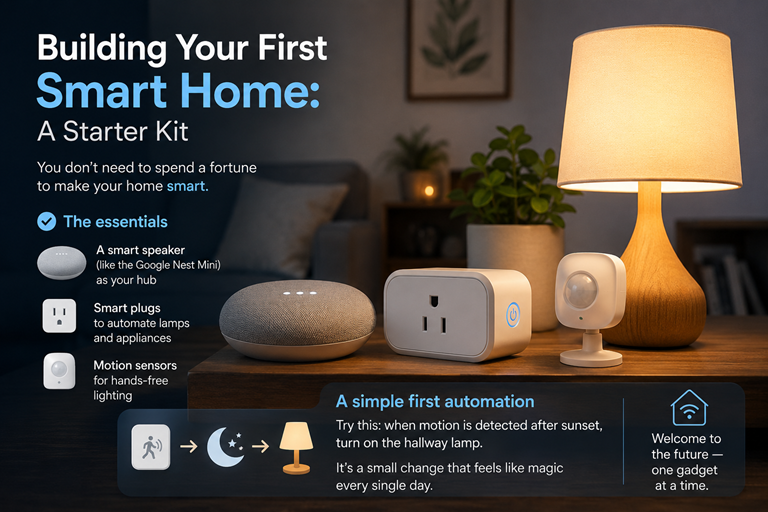
To achieve this, your starter kit needs three core components: the brain, the muscle, and the eyes.
The Essentials
   [ The Brain ]  ======>  [ The Eyes ]  ======>  [ The Muscle ]
(Smart Speaker/Hub)      (Motion Sensor)          (Smart Plug)
1. A Smart Speaker (The Brain)
Every smart home needs a centralized hub to coordinate your devices and translate your commands. A budget-friendly smart speaker is the perfect anchor.
- The Options: The Google Nest Mini or Amazon Echo Dot are excellent, cost-effective entry points. If you are deeply entrenched in the Apple ecosystem, the HomePod Mini is your go-to.
- What it does: It bridges the gap between different device brands, runs your automation logic, and gives you a voice interface when you actually want to override the system.
2. Smart Plugs (The Muscle)
Smart plugs are the unsung heroes of home automation. They simply sit between your regular wall outlet and an appliance, giving you the power to cut or supply electricity instantly.
- The Best Use Cases: Floor lamps, coffee makers, curling irons, or even holiday decorations.
- What to look for: Look for Matter-compatible Smart Plugs that support Matter or Thread. These are the current industry communication standards that ensure lightning-fast response times and universal compatibility across Apple, Google, and Amazon platforms.
3. Motion Sensors (The Eyes)
This is where the magic happens. A smart switch or plug gives you control, but a sensor gives the system context.
- Why they matter: A simple, battery-powered motion or occupancy sensor detects your physical presence in a room.
- The Benefit: It transforms passive appliances into reactive devices, allowing your home to adapt to your movements in real-time.
Quick Ecosystem Comparison
Before clicking "buy," pick an ecosystem and stick to it for your first few devices to ensure a seamless setup:
| Ecosystem | Best For | Strengths |
|---|---|---|
| Google Home | Android users & casual smart homes | Unmatched voice assistant intelligence |
| Amazon Alexa | Pure hardware compatibility | Massive library of supported third-party gadgets |
| Apple HomeKit | iOS/Mac users | Top-tier privacy and local, snappy processing |
A Simple First Automation: The Sunset Welcome
Ready to build your very first automated routine? Skip the complex triggers and try this simple blueprint. It fixes a universal human problem: walking into a pitch-black hallway with your hands full of groceries.
The Blueprint: Hallway Auto-Light
- Trigger: Motion is detected by your hallway sensor.
- Condition: Only execute if it is after sunset and before sunrise.
- Action: Turn on the hallway Matter-compatible Smart Plug (connected to a standard floor lamp).
- Delayed Action: Turn off the smart plug after 5 minutes of no detected motion.
3 Rookie Mistakes to Avoid
-
Buying the Cheapest No-Name Brands: It's tempting to buy generic smart plugs from sketchy online storefronts. Don't. They often rely on buggy, unvetted apps and present security risks. Stick to established brands like Kasa Smart Plugs, Aqara, or Hue.
-
Overcomplicating Day One: Don't try to automate your whole kitchen, your thermostat, and your garage door at the same time. You'll end up with competing routines and a frustrated household.
-
Forgetting the "Human Element": If your smart automation makes it impossible for a guest (or a less tech-savvy family member) to turn on a light manually using a normal switch, your design is flawed. Always have a physical backup.
Welcome to the Future
The beauty of a modern smart home is that it’s completely modular. By starting with just a Google Nest Mini or Amazon Echo Dot, a Matter-compatible Smart Plug, and a motion sensor, you lay a rock-solid foundation. Next month, you might add a smart thermostat; next year, a video doorbell.
Take it slow, solve one minor annoyance at a time, and welcome to the future—one gadget at a time.
Disclosure: As an Amazon Associate, we may earn from qualifying purchases. This comes at no additional cost to you and helps support our work.